
Prologue: "Peace Exists Only as a Word"
Peace in the Middle East, perhaps, is nothing more than a semantic mirage. From the assassination of Qasem Soleimani in 2020 to the forward deployment of the U.S. carrier strike group to the Strait of Hormuz in January 2026, the region has been engulfed in flames, assassinations, and an endless cycle of retaliation. These events compel us to ask the fundamental question: “Why can peace not take root here?”
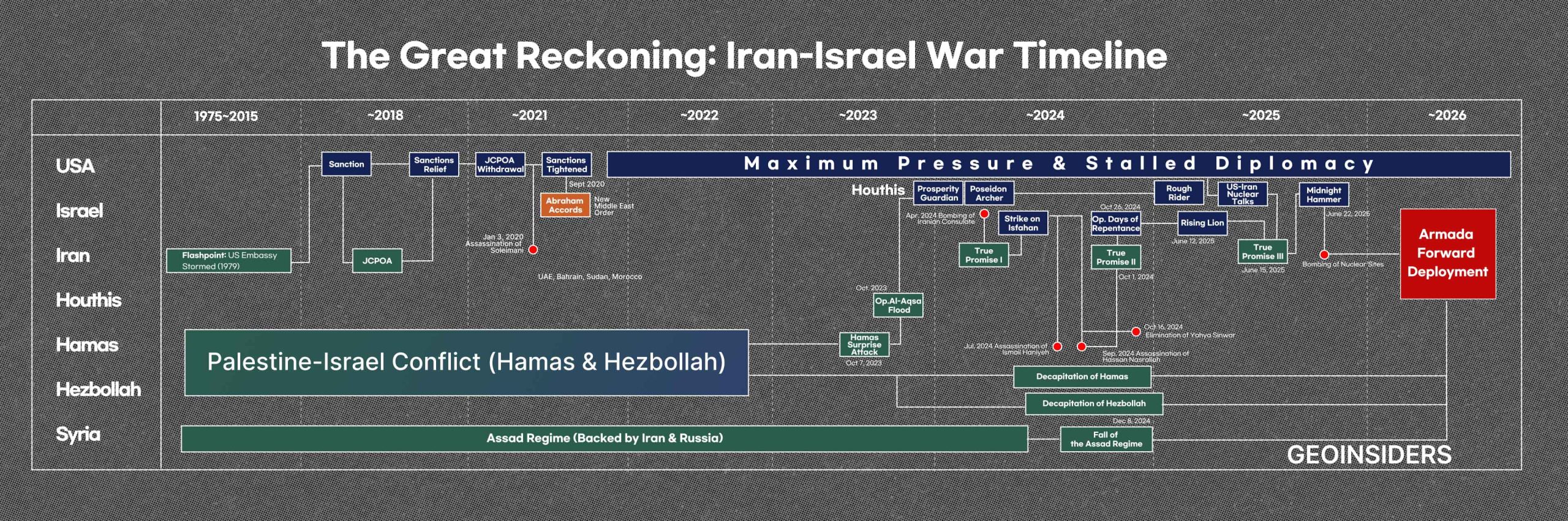
As the timeline above illustrates, this complex chain of conflict is not a series of accidental events. In the vacuum where peace should exist lies a grand design: the ‘Destructive Restructuring’ of the Middle East order, led by the United States and Israel.
At the foundation of this design lies Donald Trump’s consistent “Middle East Hegemonic Strategy.” His vision, which began in his first term with the “Abraham Accords” to isolate Iran and build a pro-American bloc, is now being executed in his second term in a physical, kinetic form—even at the cost of suspending peace. Trump possesses the temperament of a gambler who does not compromise on his goals, suggesting that peace in the Middle East will remain elusive until American hegemony is fully restored.
Following “Operation Midnight Hammer” in 2025, the U.S. has seized upon Iran’s internal turmoil to initiate the final phase of “Recapturing Middle East Hegemony.” This analysis dissects the U.S. strategy for 2026, which has chosen ‘Reshuffling’ over peace, through three key pillars: Geopolitical, Economic, and Military.
Why is a US military and economic offensive in the Middle East unavoidable? This detailed logic tree uncovers the structural reasons—saving the Petrodollar and blocking the Belt & Road Initiative—proving why the US represents an inevitable force for regime change in the region.
Pillar I: Geopolitical Perspective
The Strategy of ‘Instability for Stability’
The core of the Trump administration’s geopolitical strategy is “stability through instability.” In other words, there will be no artificial peace until forces challenging the U.S.-led order are permanently neutralized.
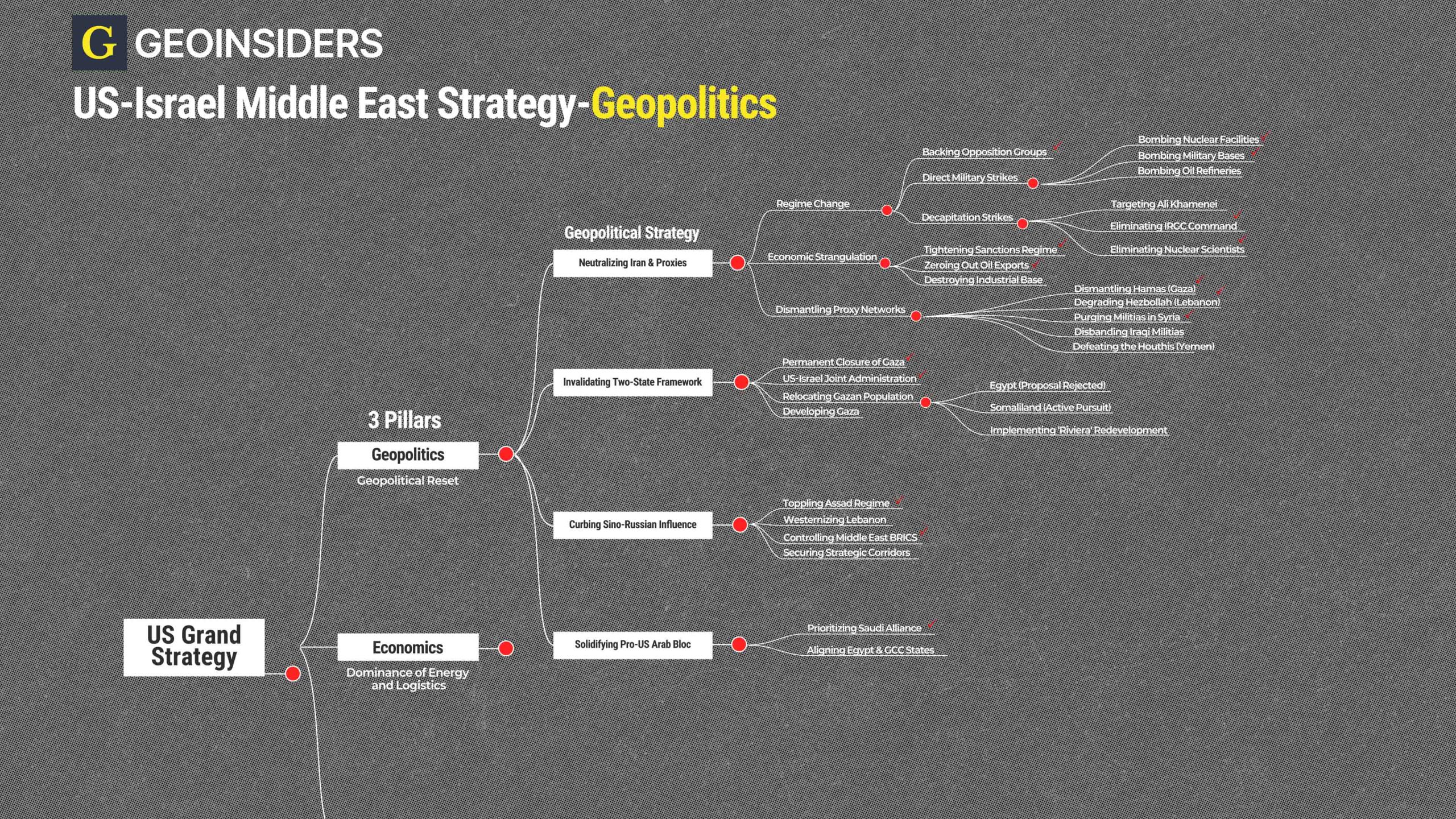
he core of the Trump administration’s geopolitical strategy is “stability through instability.” In other words, there will be no artificial peace until forces challenging the U.S.-led order are permanently neutralized.
The most urgent task is “Regime Change in Iran.” Washington has concluded that true stability in the Middle East is impossible as long as the current Iranian regime remains the primary obstacle to U.S. hegemony. Through the “12-Day War” and “Operation Midnight Hammer,” Iran’s proxies—Hamas and Hezbollah—have already suffered catastrophic damage. The only remaining threats are the Iranian mainland and the Houthi rebels threatening the Red Sea. The U.S. views the current anti-government riots within Iran not merely as unrest, but as a golden opportunity. By moving beyond sanctions to dismantling the Khamenei theocracy itself, the U.S. is paradoxically seeking peace only after the Iranian threat has been extinguished.
Simultaneously, the approach to the Palestinian issue has shifted from “peace negotiation” to “physical restructuring.” The traditional “Two-State Solution” is effectively being phased out, replaced by the “Riviera Initiative” for the Gaza Strip. This radical plan to relocate the population and redevelop the ruins of Gaza into a commercial and luxury resort zone—a “Monaco of the Middle East”—is calculated to resolve Israel’s security concerns while generating immense economic profit. The recent emergence of Somaliland as a solution for the difficult issue of population relocation must be interpreted not as a humanitarian peace process, but as a cold calculation of geopolitical exchange.
Furthermore, the U.S. is putting the brakes on the “Eastward Shift” of Arab nations, accelerated by the expansion of BRICS. By demanding a distancing from China in exchange for a powerful security umbrella for traditional allies like Saudi Arabia and the UAE, Washington is forcefully binding them back into a U.S.-centric order.
Pillar II: Economic Perspective
The Strategy of ‘Instability for Stability’
If geopolitical conflict is the skeleton, economic strategy is the blood that flows through it. Exploiting the fracture in peace, the Trump administration focuses on overwhelming competitors by controlling the choke points where capital and energy flow.
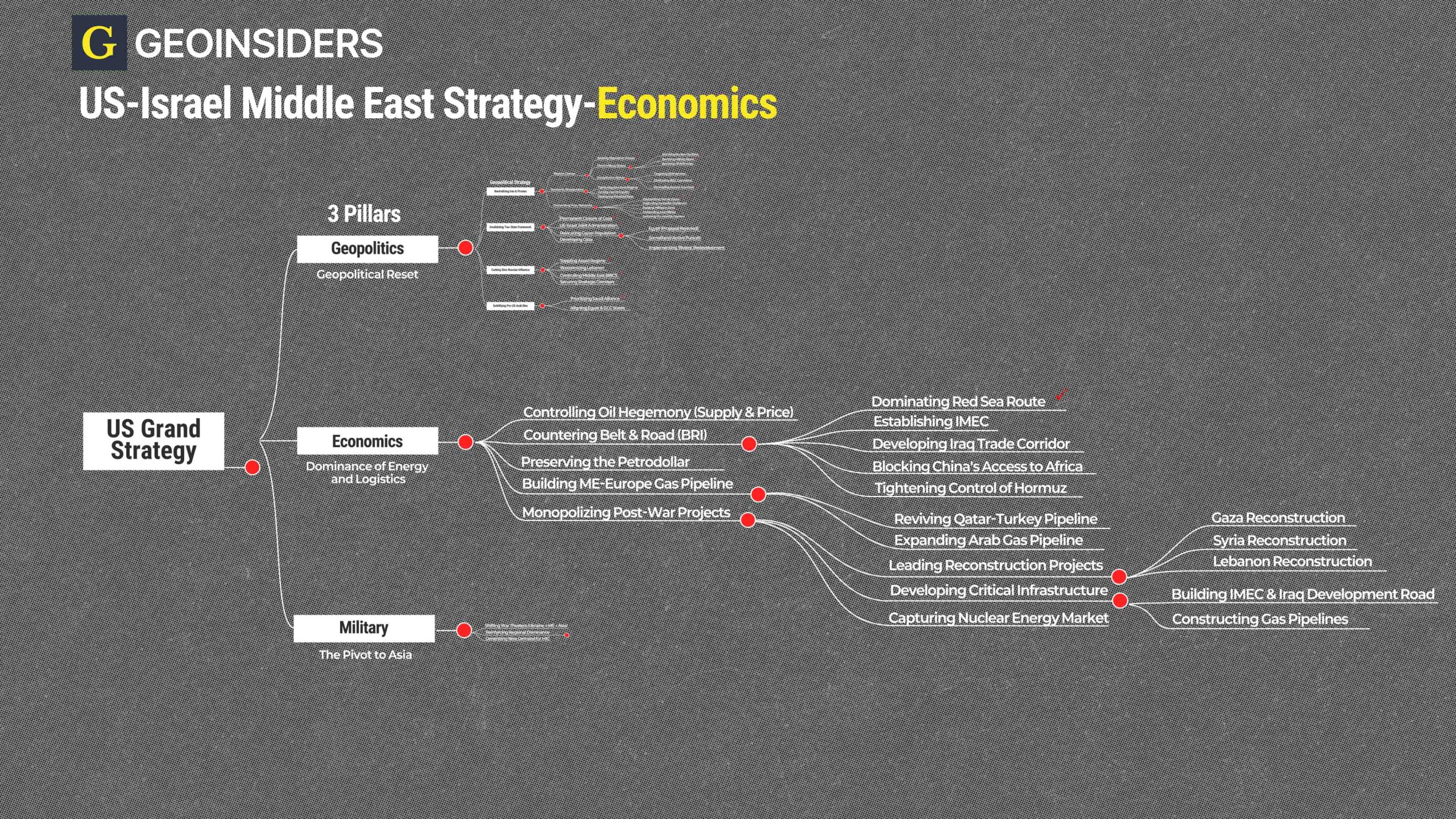
The linchpin of this strategy is the “Completion of IMEC (India-Middle East-Europe Economic Corridor).” The recent securing of the Port of Berbera in Somaliland is more than a military base expansion. It is a decisive move to place the southern gateway of the massive logistics network—spanning the Indian Ocean, Red Sea, and Mediterranean—under U.S. influence. Through this, the U.S. intends to physically block the expansion of China’s Belt and Road Initiative (BRI) and seize control of global supply chains. For the sake of economic hegemony, regional tension is dismissed as a necessary cost.
Defending Energy Hegemony is another critical axis. The U.S. is accelerating gas pipeline projects that run from Qatar through Israel to Europe. The intent is to reduce the share of Russian energy in the European market, cutting off Russia’s funding and filling the void with energy from the U.S. and its allies. This serves as a means to control pricing in international oil and gas markets and protect the dollar-based settlement system.
Finally, one must note the “Westernization of the Reconstruction Market.” The reconstruction of war-torn Gaza, Lebanon, and Syria is being designed not as humanitarian aid, but as a strict profit model. By ensuring that Western capital dominates this massive market, the U.S. is drawing a big picture to subordinate the Middle East’s real economy to the U.S.-centric financial order.
Pillar III: Military Perspective
The Middle East as a Stepping Stone to Asia
Paradoxically, the ultimate destination of Trump’s 2026 Middle East strategy is not the Middle East itself, but Asia. The answer to why there is no peace in the Middle East can be found in the fact that America’s gaze is already fixed on the Indo-Pacific.
The prerequisite for this shift is the “Locking the Back Door” strategy. The top priority of the Trump administration’s foreign policy is checking China; to do this, the main force of the U.S. military, currently dispersed in Ukraine and the Middle East, must be redeployed to Asia. The militarization of Somaliland and the unprecedented pressure on the Strait of Hormuz are part of a “cleaning operation” to completely remove or neutralize Iran—the source of instability in the rear—before the main forces depart.
Moreover, the heightening of tensions, the subsequent reconstruction, and the looming confrontation in Asia provide ceaseless opportunities for the U.S. Military-Industrial Complex. The demand for weapons and defense systems generated in the process of addressing Middle East insecurity becomes the core engine for maintaining and strengthening the U.S. defense ecosystem. Ultimately, tension in the Middle East is merely a preparatory phase for the Asia strategy.
Conclusion: Inevitable Conflict and the Outlook for 2026
The emergence of Somaliland—a nation that arguably did not exist on the diplomatic map—is the signal flare announcing that the U.S. operation to recapture Middle East hegemony has entered the execution phase.
In this massive reshuffling process, the UAE and Saudi Arabia are likely to emerge as winners, securing both security and economic utility. Conversely, Iran, trapped in the encirclement, is being forced into a final choice for regime survival. For the Trump administration, the attack on Iran and the attempt at regime change are not mere options. They are inevitable steps that must be taken to complete the grand strategy of “Pivot to Asia after Pacifying the Middle East.”
If 2025 was the year of strategy formulation and groundwork, 2026 will be the year this vision is realized through kinetic force. Why is there no peace in the Middle East? The answer is clear: For a new order to be born, the destruction of the old order must precede it. At the edge of this timeline, we are witnessing the scene where the Middle East order is fundamentally—and painfully—transforming.